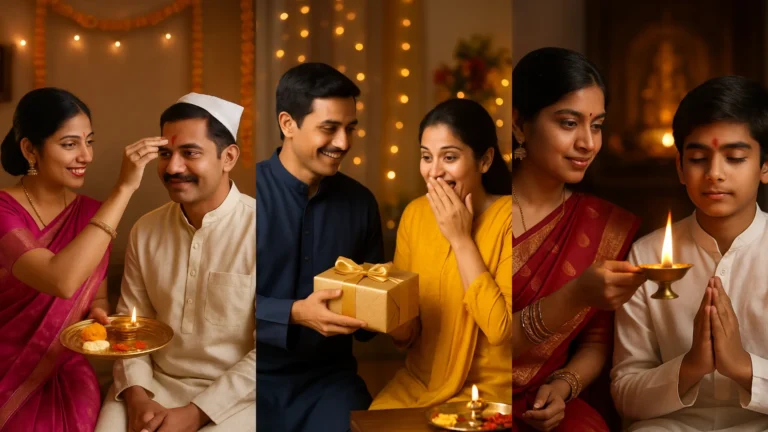
Bhau Beej, Bhai Phonta and Bhai Tika Photo Prompts (2026): 10 Regional Bhai Dooj Looks for Gemini, ChatGPT and Grok
Bhai Dooj is celebrated across India and Nepal, but every region has its own way of honouring the bond between a brother and sister. In Maharashtra it is Bhau Beej with the aukshan aarti, in Bengal it is Bhai Phonta with a sandalwood mark, in Nepal it is Bhai Tika with seven colours, and in Gujarat and North India it is Bhai Bij and the classic tilak. These 10 Bhai Dooj photo prompts recreate each of these traditions.
Upload one clear photo of you and your brother or sister together. Every prompt keeps both faces unchanged and adds the regional outfits, ritual and setting. They work in Gemini (Nano Banana), ChatGPT and Grok.
How to use these prompts
- Tap Copy prompt under the tradition you want.
- Open Gemini, ChatGPT or Grok and upload one photo with both of you in it.
- Paste the prompt and send it.
- Want a change? Reply with one small edit at a time, like “make the saree green”.
10 Bhai Dooj, Bhau Beej, Bhai Phonta and Bhai Tika photo prompts
Video tutorial: how to use these prompts
1. Bhau Beej Aukshan Aarti

Use the uploaded photo of my brother and me and keep both faces, features and skin tones exactly the same. Keep each person's face shape, age, height difference and body proportions as they are, do not beautify, smooth, swap or replace any face, and do not add or remove anyone. Create a vertical 4:5 ultra-photorealistic festive portrait of the Maharashtrian Bhau Beej aukshan, with the sister doing aarti for her brother. The sister wears a purple nauvari saree with a gold Paithani-style border, a green blouse, a pearl nath, a gold thushi necklace, green glass bangles with gold patlya and a crescent chandrakor bindi, with her hair in a bun with a white gajra. The brother wears a cream silk kurta with a maroon Nehru jacket, white churidar and a saffron pheta-style turban, with a kumkum tilak on his forehead. He sits on a low wooden paat placed on a colourful rangoli, while she stands in front of him holding a brass aarti thali with a lit diya, rice, kumkum and a sweet, moving it in a slow circle around his face; he smiles up at her and she smiles back. Around them are an orange akash kandil lantern hanging above, clay diyas around the rangoli, marigold torans on a carved wooden door and a brass plate of karanji. The light is warm golden from the diya and lantern with a soft frontal fill so both faces are clear and gentle bokeh behind. Shot on a 50mm lens at f/2 at chest height, full-length framing of both with the rangoli in the foreground. Colour palette of purple, saffron, gold and marigold; mood loving, traditional and joyful. Natural skin texture, realistic fabric folds and jewellery shine, sharp focus on the eyes, high detail; no text, no watermark, no extra or missing people, no distorted hands or fingers, and every face exactly as in the uploaded photo.
Tip: Ask for a green nauvari with a pink border for a brighter Maharashtrian look.
2. Bhau Beej Sweets on the Paat

Use the uploaded photo of my brother and me and keep both faces, features and skin tones exactly the same. Keep each person's face shape, age, height difference and body proportions as they are, do not beautify, smooth, swap or replace any face, and do not add or remove anyone. Create a vertical 4:5 ultra-photorealistic candid portrait of a sister feeding her brother a sweet on Bhau Beej. The sister wears a magenta Paithani silk saree with a green and gold border, a green blouse, gold earrings, a slim mangalsutra-style gold chain, green and gold bangles and a small bindi, with her hair in a low bun with jasmine. The brother wears a bottle-green cotton silk kurta with gold buttons, a white churidar and a light gold stole, with a tilak on his forehead and neatly combed hair. He sits on a decorated wooden paat on the floor with a flower rangoli around it, and she kneels beside him, lifting a karanji to his mouth with one hand while holding a brass plate of sweets in the other; both are laughing, his eyes squeezed shut. In front of them is a brass thali with a diya, kumkum, rice and a small gift box, with marigold garlands and clay diyas lining the floor and a living room softly blurred behind. The light is warm late-afternoon window light from the left with a golden fill from the diya and soft shadows. Shot on a 35mm lens at f/2.8 at their eye level, three-quarter framing of both, the sweet and their faces sharp. Colour palette of magenta, green, gold and warm cream; mood playful, sweet and close. Natural skin texture, realistic fabric folds and jewellery shine, sharp focus on the eyes, high detail; no text, no watermark, no extra or missing people, no distorted hands or fingers, and every face exactly as in the uploaded photo.
Tip: Swap the karanji for puran poli if that is your family tradition.
3. Bhau Beej Gift by the Akash Kandil

Use the uploaded photo of my brother and me and keep both faces, features and skin tones exactly the same. Keep each person's face shape, age, height difference and body proportions as they are, do not beautify, smooth, swap or replace any face, and do not add or remove anyone. Create a vertical 4:5 ultra-photorealistic portrait of a brother giving his sister a Bhau Beej gift on a balcony at dusk. The sister wears a yellow cotton silk saree with a red and gold border, a red blouse, small gold jhumkas, red and gold bangles and a tiny bindi, with her hair in a side braid with orange kanakambaram flowers. The brother wears an off-white kurta with a mustard Nehru jacket, white pyjamas and a red tilak on his forehead, with neatly styled hair. They stand facing each other by the balcony railing; he holds out a small velvet gift box with both hands and she covers her mouth with one hand in happy surprise, her eyes wide and smiling. A big orange star-shaped akash kandil hangs above them, clay diyas line the railing, a marigold garland is wrapped around it and the building opposite glows with fairy lights. The light is the warm lantern glow mixed with soft blue twilight, a gentle fill on both faces and soft golden bokeh. Shot on a 50mm lens at f/2 at eye level, waist-up framing of both in profile toward each other, the lantern at the top of the frame. Colour palette of yellow, mustard, red and lantern orange; mood surprised, warm and affectionate. Natural skin texture, realistic fabric folds and jewellery shine, sharp focus on the eyes, high detail; no text, no watermark, no extra or missing people, no distorted hands or fingers, and every face exactly as in the uploaded photo.
Tip: Ask for the gift wrapped in red paper with a gold ribbon for a brighter colour pop.
4. Bhai Phonta Sandalwood Tilak

Use the uploaded photo of my brother and me and keep both faces, features and skin tones exactly the same. Keep each person's face shape, age, height difference and body proportions as they are, do not beautify, smooth, swap or replace any face, and do not add or remove anyone. Create a vertical 4:5 ultra-photorealistic portrait of the Bengali Bhai Phonta ritual, with the sister applying sandalwood phonta to her brother's forehead. The sister wears a white cotton taant saree with a broad red border, the pallu draped in the Bengali style, a red blouse, shakha-pola-style red and white bangles, small gold earrings and a large red bindi, with her hair in a neat bun. The brother wears a white cotton dhoti and a cream panjabi kurta, with neatly combed hair. He sits cross-legged on a decorated floor mat with an alpana pattern around it, while she sits facing him and gently touches his forehead with the little finger of her left hand dipped in sandalwood paste; he closes his eyes with a calm smile. Between them is a brass plate with sandalwood, kajal, a lit ghee lamp, dhaan-durbo grass, sweets like sandesh and a small conch, with marigolds and clay lamps around the alpana. The light is soft morning daylight from a window with a warm glow from the lamp and gentle shadows. Shot on a 50mm lens at f/2.2 at their eye level, three-quarter framing with both faces and the forehead touch sharp. Colour palette of white, red, sandalwood yellow and soft gold; mood pure, tender and traditional. Natural skin texture, realistic fabric folds and jewellery shine, sharp focus on the eyes, high detail; no text, no watermark, no extra or missing people, no distorted hands or fingers, and every face exactly as in the uploaded photo.
Tip: Ask for a red-bordered garad silk saree for a more festive Bengali look.
5. Bhai Phonta Feast
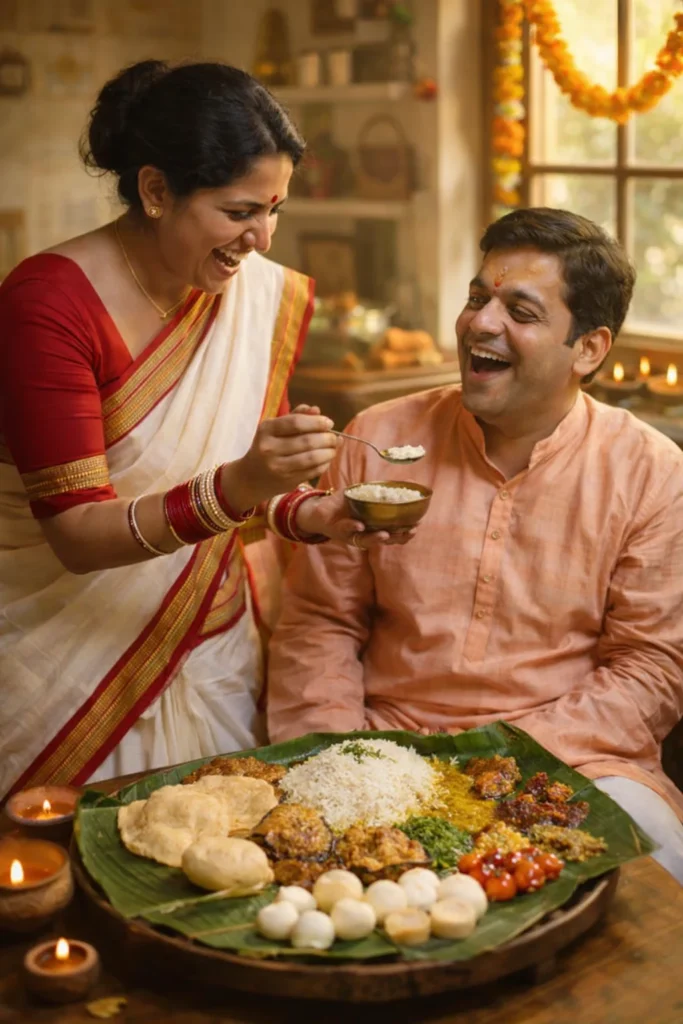
Use the uploaded photo of my brother and me and keep both faces, features and skin tones exactly the same. Keep each person's face shape, age, height difference and body proportions as they are, do not beautify, smooth, swap or replace any face, and do not add or remove anyone. Create a vertical 4:5 ultra-photorealistic candid portrait of a Bengali sister serving her brother a Bhai Phonta feast. The sister wears a red and white Bengali saree with a gold border, the pallu tucked at the waist, red and white bangles, small gold earrings and a red bindi, with her hair in a loose bun. The brother wears a peach panjabi kurta with white pyjamas and a sandalwood phonta mark on his forehead, with neatly combed hair. He sits at a low wooden table with a big banana-leaf plate full of rice, dal, fish curry, luchi, begun bhaja, chutney and a row of sweets like roshogolla and sandesh, while she stands beside him spooning more payesh into a small bowl, both laughing as he pretends he cannot eat any more. Around them are marigold garlands on the window, clay lamps on the sill and a warm home kitchen softly blurred behind. The light is soft warm daylight from the window on the right with a gentle golden fill, bright and appetising. Shot on a 35mm lens at f/2.8 from slightly above, three-quarter framing with the feast in the foreground and both faces clearly visible. Colour palette of red, white, peach and warm gold; mood fun, loving and homely. Natural skin texture, realistic fabric folds and jewellery shine, sharp focus on the eyes, high detail; no text, no watermark, no extra or missing people, no distorted hands or fingers, and every face exactly as in the uploaded photo.
Tip: Ask for a kansa-metal thali instead of a banana leaf for a different look.
6. Bhai Phonta Conch Moment
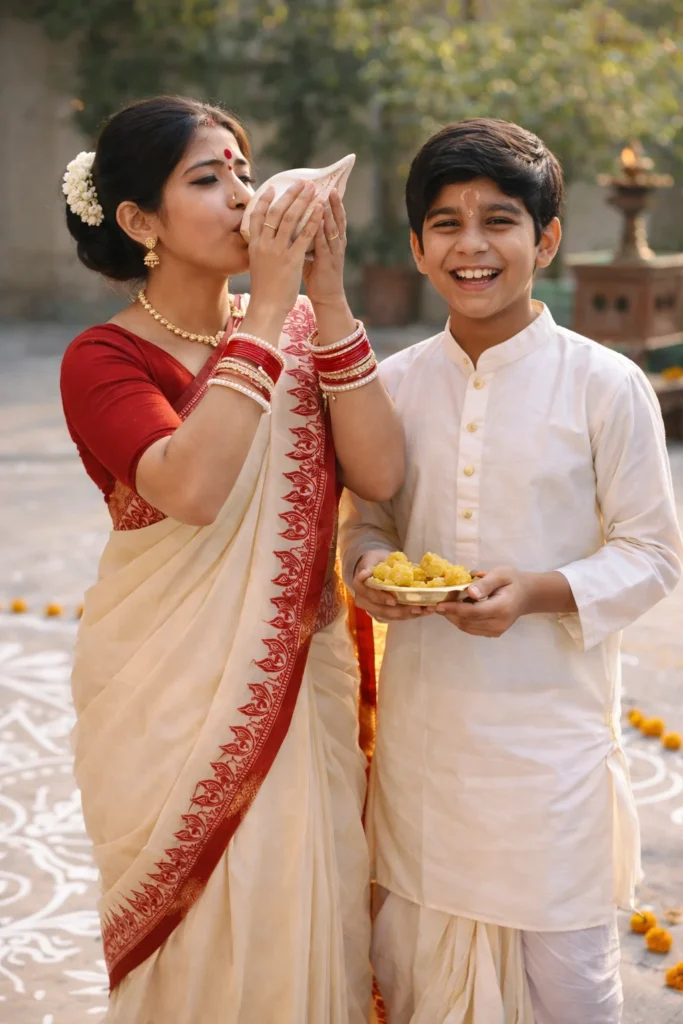
Use the uploaded photo of my brother and me and keep both faces, features and skin tones exactly the same. Keep each person's face shape, age, height difference and body proportions as they are, do not beautify, smooth, swap or replace any face, and do not add or remove anyone. Create a vertical 4:5 ultra-photorealistic portrait of a sister blowing a conch shell after the Bhai Phonta ritual while her brother smiles beside her. The sister wears a cream garad silk saree with a deep red border and red paisley motifs on the pallu, a red blouse, red and white bangles, a gold necklace and a large red bindi, with her hair in a bun with a few white flowers. The brother wears a white silk panjabi with gold buttons, a white dhoti and a sandalwood phonta on his forehead, with neatly combed hair. They stand side by side on a sunlit courtyard; she holds a white shankh to her lips with both hands, cheeks gently puffed, while he holds a small brass plate of sweets and laughs, looking at the camera. Around them a large white alpana is painted on the floor, clay lamps and marigolds line its edge and a tulsi planter with a lamp stands behind them. The light is bright morning sunlight from the side with soft bounce from the white floor and warm highlights on the silk. Shot on a 50mm lens at f/2.2 at eye level, waist-up framing of both with the alpana visible at the bottom. Colour palette of cream, deep red, white and soft gold; mood joyful, festive and bright. Natural skin texture, realistic fabric folds and jewellery shine, sharp focus on the eyes, high detail; no text, no watermark, no extra or missing people, no distorted hands or fingers, and every face exactly as in the uploaded photo.
Tip: Ask for evening lamp light instead of morning sun for a deeper glow.
7. Nepali Bhai Tika with Seven Colours

Use the uploaded photo of my brother and me and keep both faces, features and skin tones exactly the same. Keep each person's face shape, age, height difference and body proportions as they are, do not beautify, smooth, swap or replace any face, and do not add or remove anyone. Create a vertical 4:5 ultra-photorealistic portrait of the Nepali Bhai Tika, with the sister placing a seven-coloured saptarangi tika on her brother's forehead. The sister wears a red velvet chaubandi cholo blouse with a red and gold fariya saree, a gold tilhari necklace with green pote beads, gold earrings and red bangles, with her hair in a neat braid. The brother wears a white daura suruwal with a dark waistcoat and a Dhaka-patterned topi, with a garland of purple and white makhamali flowers around his neck. He sits cross-legged on a mat on the floor, while she sits in front of him carefully pressing the long colourful tika onto his forehead with her fingers; he looks at the camera with a proud, gentle smile. Between them is a brass plate with coloured tika powders, rice, walnuts, dried fruits, sel roti, a lit oil lamp and a small marigold garland. The light is soft warm daylight from a window mixed with the glow of the oil lamp, even and clear. Shot on a 50mm lens at f/2.2 at their eye level, three-quarter framing with the tika and both faces sharp. Colour palette of red, white, purple makhamali and gold; mood proud, loving and traditional. Natural skin texture, realistic fabric folds and jewellery shine, sharp focus on the eyes, high detail; no text, no watermark, no extra or missing people, no distorted hands or fingers, and every face exactly as in the uploaded photo.
Tip: Add "an oil line drawn around my brother on the floor" for the full Bhai Tika ritual.
8. Bhai Tika Gift and Blessing
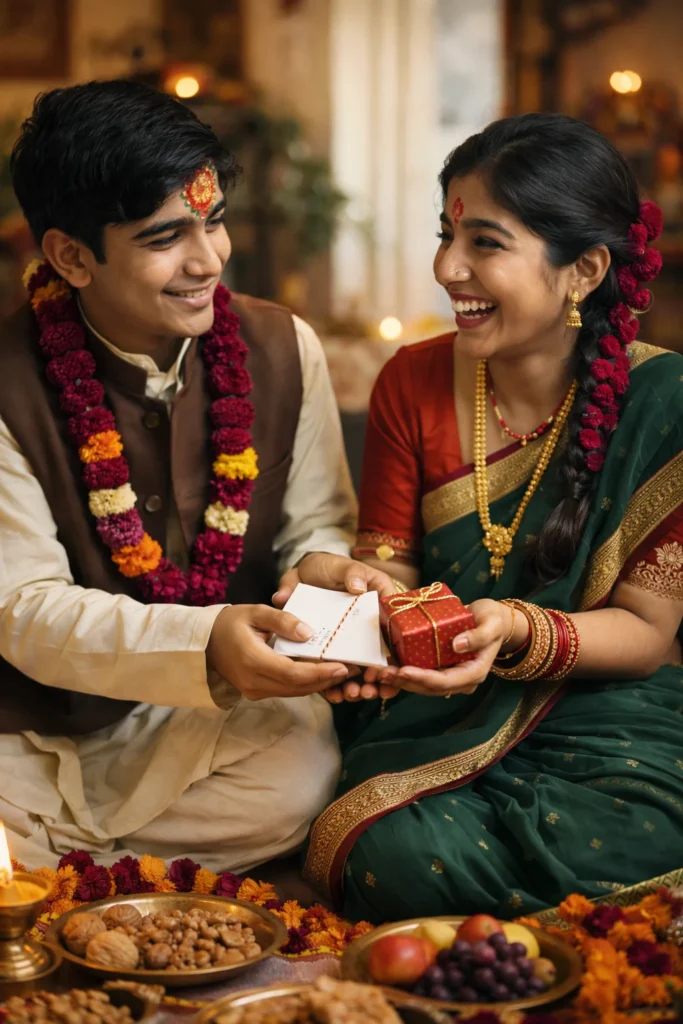
Use the uploaded photo of my brother and me and keep both faces, features and skin tones exactly the same. Keep each person's face shape, age, height difference and body proportions as they are, do not beautify, smooth, swap or replace any face, and do not add or remove anyone. Create a vertical 4:5 ultra-photorealistic candid portrait of a brother giving his sister a gift after the Nepali Bhai Tika. The sister wears a deep green fariya saree with a gold border and a red blouse, a gold tilhari necklace with red pote beads, gold earrings and a red tika on her forehead, with her hair in a side braid with makhamali flowers. The brother wears a cream daura suruwal with a brown waistcoat and a colourful saptarangi tika on his forehead, with a makhamali flower garland around his neck. They sit together on a floor mat; he places an envelope and a small gift box into her hands with both of his, and she accepts it with a bright laugh while he smiles warmly at her. Around them are brass plates with walnuts, sel roti and fruits, marigold and makhamali garlands, a lit oil lamp and a warmly decorated room softly blurred behind. The light is soft late-morning daylight from the left with a gentle golden fill from the lamp and clean shadows. Shot on a 35mm lens at f/2.8 at their eye level, three-quarter framing with the gift and both faces in focus. Colour palette of green, red, cream and marigold; mood grateful, warm and happy. Natural skin texture, realistic fabric folds and jewellery shine, sharp focus on the eyes, high detail; no text, no watermark, no extra or missing people, no distorted hands or fingers, and every face exactly as in the uploaded photo.
Tip: Ask for the scene outdoors on a sunny terrace with marigolds for a brighter version.
9. Gujarati Bhai Bij Kumkum Tilak
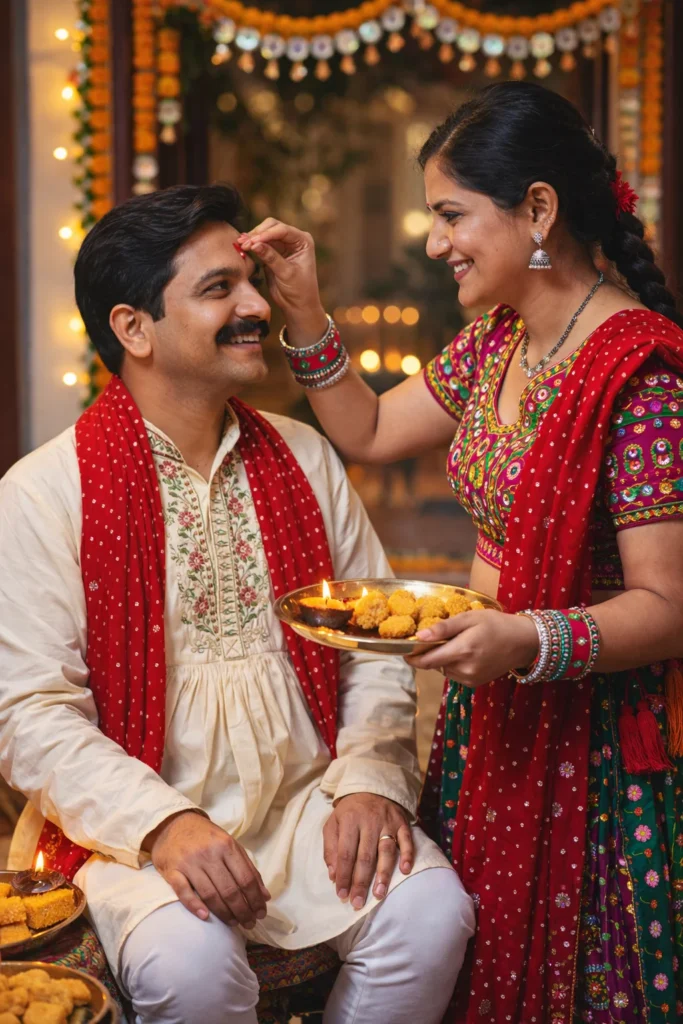
Use the uploaded photo of my brother and me and keep both faces, features and skin tones exactly the same. Keep each person's face shape, age, height difference and body proportions as they are, do not beautify, smooth, swap or replace any face, and do not add or remove anyone. Create a vertical 4:5 ultra-photorealistic portrait of the Gujarati Bhai Bij, with the sister applying a kumkum tilak to her brother at home. The sister wears a mirror-work chaniya choli in deep pink with green and yellow embroidery and a red bandhani dupatta pinned over her shoulder, with oxidised silver jhumkas, mirror-work bangles and a small bindi, with her hair in a braid with a red tassel. The brother wears an off-white kediyu-style kurta with gathered flare and embroidered yoke, white churidar and a red bandhani stole, with neatly styled hair. He sits on a low decorated stool while she stands in front of him, pressing a kumkum and rice tilak onto his forehead with her thumb and holding a brass thali with a lit diya and sweets in her other hand; both smile at each other. Around them are a colourful rangoli, clay diyas, a toran of mirrors and marigolds on the doorway and brass plates of mohanthal and ghughra. The light is warm early-evening light from the diyas and a lamp with a soft frontal fill so both faces are clear and gentle bokeh behind. Shot on a 50mm lens at f/2 at chest height, three-quarter framing of both with the thali in the foreground. Colour palette of pink, red, mirror silver and marigold; mood bright, festive and loving. Natural skin texture, realistic fabric folds and jewellery shine, sharp focus on the eyes, high detail; no text, no watermark, no extra or missing people, no distorted hands or fingers, and every face exactly as in the uploaded photo.
Tip: Ask for a bandhani dupatta in pink and green for more traditional Gujarati colour.
10. North Indian Bhai Dooj Tilak with Gola
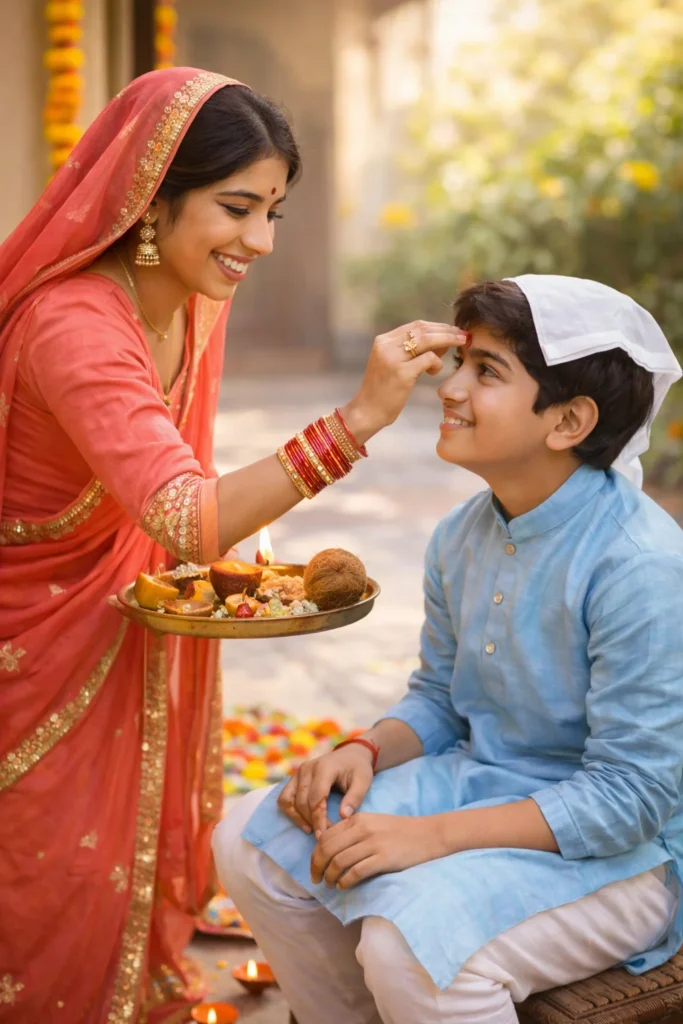
Use the uploaded photo of my brother and me and keep both faces, features and skin tones exactly the same. Keep each person's face shape, age, height difference and body proportions as they are, do not beautify, smooth, swap or replace any face, and do not add or remove anyone. Create a vertical 4:5 ultra-photorealistic portrait of the North Indian Bhai Dooj, with the sister doing tilak for her brother and offering a dry coconut gola. The sister wears a coral-pink cotton silk suit with gold gota-patti borders and a matching dupatta over her head, with gold jhumkas, coral and gold bangles and a small bindi. The brother wears a sky-blue cotton silk kurta with white churidar, a red mauli thread on his wrist and a white handkerchief placed on his head for the ritual. He sits on a low wooden chowki while she stands before him, placing a roli and rice tilak on his forehead with her ring finger and holding a brass thali with a lit diya, a small gola, sweets and dry fruits in her other hand; he looks up at her with a warm smile. Around them is a small rangoli at their feet, clay diyas on the floor, marigold garlands on the door and a sunny courtyard softly blurred behind. The light is soft warm late-morning daylight from the left with a golden fill from the diya and clean, gentle shadows. Shot on a 50mm lens at f/2 at chest height, three-quarter framing of both with the tilak moment sharp. Colour palette of coral pink, sky blue, gold and marigold; mood loving, traditional and bright. Natural skin texture, realistic fabric folds and jewellery shine, sharp focus on the eyes, high detail; no text, no watermark, no extra or missing people, no distorted hands or fingers, and every face exactly as in the uploaded photo.
Tip: Ask for the brother wearing a cream kurta with a maroon stole for a warmer palette.
Outfit and colour ideas for regional Bhai Dooj photos
Each tradition has its own look, and matching it makes the photo feel real and personal.
Bhau Beej: nauvari and Paithani
A nauvari or Paithani saree with a pearl nath and chandrakor bindi, and a kurta with a pheta or Nehru jacket for the brother, instantly reads as Maharashtrian.
Bhai Phonta: white and red
A white saree with a red border, red and white bangles and a large bindi for the sister, with a panjabi kurta and dhoti for the brother, gives the classic Bengali look.
Bhai Tika, Bhai Bij and North Indian tilak
For Nepal, a red fariya with a tilhari necklace and a daura suruwal with topi. For Gujarat, a mirror-work chaniya choli and kediyu. For North India, a simple silk suit and kurta work beautifully.
Tips for better results
- Use one photo where both siblings face the camera and are about the same size.
- Mention who is older or taller if the app mixes up your heights.
- If a ritual detail looks wrong, reply with one correction, like “use the little finger for the phonta”.
- Keep the sweets and thali in the prompt; they make the scene feel authentic.
More Bhai Dooj prompts
Find every look on the Bhai Dooj image prompts hub, and see our Bhai Dooj brother-sister photo prompts. Still celebrating Diwali? Browse the Diwali image prompts hub, Diwali family photo prompts and Diwali wishes photo prompts, or all prompts for family.
Frequently asked questions
Are these Bhai Dooj prompts free?
Yes. All 10 prompts are free to copy and use. Gemini, ChatGPT and Grok may limit how many images you can create on a free plan.
Can I use a photo of two sisters or two brothers?
Yes. Change the words sister and brother in the prompt to match the people in your photo, and keep the rest of the ritual and setting.
Which tradition should I choose?
Pick the one your family follows, or try another region for fun. Each prompt describes the outfits, ritual and food of one tradition so the photo looks true to it.
Can I add our parents to the photo?
These prompts are written for two siblings. For a bigger group, use a family photo and add a line such as “our parents stand behind us smiling”, and mention the total number of people.